

How Connected Monitoring and Machine Utilisation Improve Factory Management
The old-fashioned way of checking machine performance requires the supervisor to walk up to the machine at regular intervals and check its status. They would either use digital meters or machine readings to evaluate each machine during their visit and use this information to determine how well each machine is performing. Although this method gives some level of insight into how well the machines are working, it is time-consuming, and the information gained is usually only a snapshot view of each machine.
Most machines currently in use have their own performance capture mechanisms that can produce data to help supervisors with efficient machine management. For example, a machine can produce data about how much material it has used, the instances and duration of downtime, its production rate, and sensor readings such as energy consumption or levels of vibration during operation. However, most of this information is stored within individual machines, which makes it difficult for supervisors to get a complete and up-to-date view of overall shop floor performance in a single check. As a result, operational decisions are often made with partial visibility rather than a wholesome and timely view of factory operations.
Therefore, this presents a need to move towards a more connected and real-time way to monitor machines, preferably one that combines machine utilisation, machine downtime, and information from key sensors to create an overall view of factory performance.
What is Machine Utilisation?
Machine utilisation reflects how effectively a machine’s available operating time is put to use. Quantitatively, it is expressed as a ratio between the time that a machine is running and the total time that the machine is available. Simply put, machine utilisation looks at how much time a machine is actively running, being idle, or completely stopped.
Therefore, a machine can be in one of the three operational states as follows:
| Machine State | Description | Operational Impact |
|---|---|---|
| Running | Machine actively producing output | Productive operating time |
| Idle | Machine-powered but not producing output | Reduced efficiency and lost production time |
| Stopped | Machine unavailable due to maintenance, breakdowns, or planned downtime | Production interruption and downtime losses |
When you look at how long a machine spends in each of these operational states, it gives a comprehensive idea of how well the machine is being utilized and how efficiently it is operating. For example, this analysis would be able to clearly reflect any material delays or frequent stoppages due to poor operational scheduling.
Overall, machine utilization is key to productivity in manufacturing environments. If machines are appropriately utilized, productivity improves without any additional expense. Conversely, if machines are not being utilized well, it leads to wasted time, higher costs, and reduced efficiency.
By analysing utilization data, factory managers can make better-informed decisions on adjusting production plans, identifying machines that are not meeting performance targets, and minimizing occurrences of breakdowns. When utilization is combined with sensor data, it can go a step further and explain why each machine is operating differently, thereby allowing targeted improvement efforts to be developed.
What Other Sensor Parameters Should Be Monitored?
Coupling the insights on effective machine use (gained via machine utilisation) with additional sensor parameters provides a deeper machine-level understanding of floor operations. It can answer the whys and the hows behind a machine performance, giving a complete picture of the shop floor operations. Some additional sensor parameters worth considering are as follows:
Machine State and Error Conditions
Monitoring machine state and errors gives insight into the way the machines are functions and any occurrences of machine failures. If a machine encounters frequent errors or recurrent interruptions that can indicate an underlying mechanical or operational issue. Being able to identify these conditions gives the supervisors the advantage of responding to them before they spiral beyond a simple fix.
Cycle and Production Counts
In addition to machine and error states, cycle count and production output provide supervisors with a basis for understanding how much work is completed in a given time frame. This helps in comparing the anticipated output against the actual output, enabling the identification of underperforming machines and bottlenecks in the production process.
Downtime Frequency and Duration
Downtime can occur due to various reasons such as machine failure, lack of materials, or pre-planned shutdowns. The data derived from monitoring production downtime helps in visualizing how often and for how long machines are in an inactive state. Tracking the extent of downtime will provide factories with the opportunity to eliminate production losses and improve scheduling efficiency.
Monitoring Energy Use
Energy monitoring helps a factory to evaluate how well its equipment is running in power consumption perspective. For example, if a factory records an abnormal increase in energy consumption, it could be an indicator of poor operation, heavy load conditions, or a developing a mechanical problem that will require further investigation.
Temperature & Vibration
Monitoring equipment for changes in temperature and vibrations can help flag abnormal machine performance. For example, if a machine records a sudden increase in vibration or an increase in operating temperature, it may be an indicator of machine imbalance, lack of lubrication, or an imminent equipment failure Therefore, maintenance teams can promptly respond to these issues before they become catastrophic.
By monitoring these parameters in combination with machine utilisation, factories will gain the ability to transform their decision-making process form a reactive mindset towards a more proactive and data-driven approach.
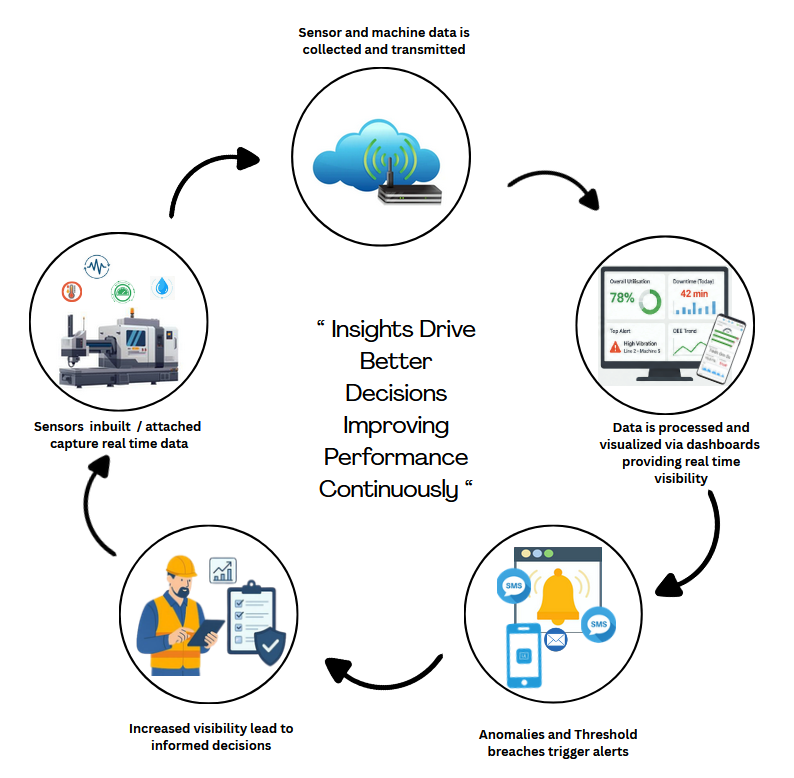
How Connected Monitoring Improves Factory Management
A common yet one of the major challenges in factory operation management is maintaining real-time shop floor visibility. In a traditional setting, supervisors usually depend upon periodic machine inspection and operator reports to ascertain production progress and machine condition. Besides being time-consuming, this also makes it difficult to maintain a complete and current view of factory operations.
Connected monitoring eliminates this problem by linking machine utilisation and sensor data of multiple machines to a centralized system. Rather than checking each piece of equipment independently, supervisors and factory managers can now observe the machine conditions, production activity, and operational status and many more from one interface. This greatly increases visibility throughout the factory and allows for quick detection of operational bottlenecks.
Furthermore, it comes with the added advantage of improved coordination and decision-making. With real-time access to operational data, supervisors can easily spot the machines that fall short of production expectations, production bottlenecks, and excessive downtime. This can greatly improve production efficiency, production planning, and resource allocation. Additionally, all of the real-time data reduces the need for constant manual supervision, allowing most of the factory personnel to dedicate more time and energy toward operational improvements rather than monitoring routine activities.
With connected monitoring systems in place, factories can also improve on operational scalability. As factories grow larger and the number of machines increases, keeping track of machine condition and production activity on a manual basis becomes much harder. Having centralized monitoring of multiple machines and operational parameters allows for the concurrent supervision of all these machines without the need for additional cadre resources as supervisory personnel.
The benefits of connected monitoring are already being demonstrated with a widespread of factory deployments. Recently Protonest, an IoT solution provider, successfully installed a CNC machine utilization monitoring system for GREM, a precision machining company based in France. The system linked the power-based machine utilisation data to provide a centralized view, enhancing the level of operational visibility.
Challenges and Consideration
Even though machine utilisation and sensor-based monitoring can be easily integrated without a complete infrastructure overhaul, factories may still encounter certain challenges in deploying and managing these systems. Being aware of these challenges allows factories to set more realistic expectations, enabling a smoother transition to connected monitoring.
Legacy Machine Integration
Although many machines can be easily linked to the central system for data collection, not every machine might be able to support modern monitoring systems. Especially when working with legacy equipment, they might often lack the necessary communication capabilities, making it a more challenging deployment. In such cases, additional sensors or interfaces may be needed to successfully capture the machine data.
Managing Large Amounts of Data
As the number of monitored machines and sensor parameters increases, it proportionally increases the amount of operational data generated by the factory. This calls for an adequate structure to gather and filter this data and turn it into useful information. Therefore, well-organized intelligent dashboards and support structures would be necessary to gain more focused and meaningful insights.
Initial Setup and Use
When setting up the monitoring system, it requires proper planning and implementation to achieve its benefits in full. Proper sensor placement; checking machine compatibility; and dashboard configuration, if not done correctly, can make a negative impact on the system performance. Furthermore, employee knowledge and experience in using the monitoring system are also crucial aspects in realizing the maximum potential of the system in the day-to-day activities performed in the factory.
Gradual System Expansion
Factories often start by collecting data for a few machines before rolling out the entire operation. This helps ensure that the system works as an efficient way to monitor the production line, and it gives the associated factory teams time to adapt to the new processes associated with the machines using a connected system.
When properly planned and set up, connected monitoring systems can assist factories in improving supervision, reducing inefficiencies, and managing operations more effectively over time.
Conclusion
Monitoring machine utilisation along with key sensors becomes an important consideration to maintain an efficient and reliable production environment as the complexity and amount of data created during factory operations increases. Connected monitoring creates operational visibility and promotes better decision-making; so that factories promptly respond to production problems.
While implementation will still require some planning, connected monitoring systems provide a practical and valuable addition to today's manufacturing operations.
References
- MachineMetrics. Machine Utilization: What It Is and Why It Matters. Available at: https://www.machinemetrics.com/blog/machine-utilization
- Evocon. Machine Utilization. Available at: https://evocon.com/articles/machine-utilization/
- Dashtera. Smart Manufacturing IoT Cloud Monitoring Dashboard. Available at: https://dashtera.com/articles/smart-manufacturing-iot-cloud-monitoring-dashboard/
- Smart Factory. Benefits of Real-Time Monitoring in Production. Available at: https://smartfactory.com.tr/en/benefits-of-real-time-monitoring-in-production/
- Protonest Connect. First Feedback from a Real-World Protonest Connect Deployment [LinkedIn post]. Available at: https://www.linkedin.com/posts/protonest-connect_first-feedback-from-a-real-world-protonest-activity-7439185490982936576-Agal/?utm_source=share&utm_medium=member_desktop&rcm=ACoAACyLIJsBWFm3LNsRDvEiYIfG2yGREv6F3Sc
Other Blogs

Hidden Causes of Factory Downtime in Sri Lankan Manufacturing
When running a factory, downtimes are inevitable. While major breakdowns get all the attention, it is the minor, scattered, and unrecorded stoppages that quietly add up to the largest revenue losses.
5 min read
Why Repeated Machine Failures Keep Happening in Factories - And How to Break the Cycle
When a machine breaks down, you repair it and move on. But then it breaks down again, in the same way. Repeated failures are not a machine problem — they are an information and process problem.
6 min read